Leaving Sol

Updates

Every build of Leaving Sol, newest first. Screenshots are from the build in question; numbers and names still change as the game is tuned.


Build

The war at Castor

Fifty-one light years out, two houses of one alien people, the Ascendancy and the Free Fleet, have been fighting over Castor for two hundred years. Their station changes hands as the war swings, and now you can swing it.

  • Clashes: watch the houses fight, or join in. Lances hurt most when you sit still, scatter-cannons up close, torpedoes can be shot down by your flak, and a harpoon reels you in until you shoot its bow gun or burn hard enough to break the line.
  • Standing: each house rates you from Hostile to Honoured. Docking, contracts, the better wares and finally the house’s own gear open as you climb. Every favour to one costs you with the other.
  • House contracts: escorts, strikes on the other side’s supply line, supplies for the siege and rescues from the Battlefield, where the wrecks are worth stripping too. While the station is under siege, the battle round it is open to anyone.
  • Flagships: one for each house, back about a day after you beat it. Very rarely one drops a piece of named gear, like the Throne lance, Herald plate, Long line or Widowmaker. Your Collection log keeps track.
  • House hulls: reach Honoured and a house’s shipwrights will fit your mind into one of their own hulls.

Also new: your guns fire from their own turrets. Rings of stars out from Sol show how dangerous each one is, and deliveries pay more the further they go, up to 1.6 times as much. Research has a Combat branch, and the Mk V engine and drone bay are now clearly better than the Mk IV. The Map opens full screen with a System and Galaxy switch. Station storage holds any amount, and the grappler is back for Mk I and II, with the tractor beam from Mk III. Flying is quieter too: the autopilot only speaks up when it has something new to say.
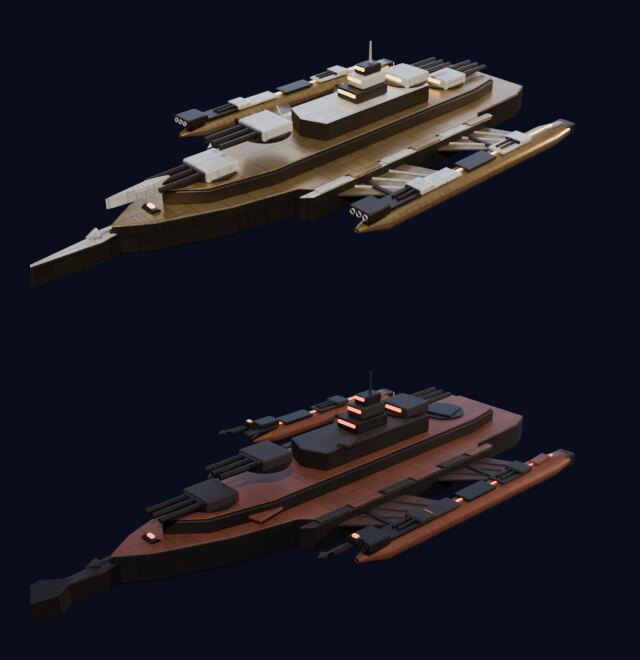
The two houses' cruisers, in bronze and in rust: concept renders

Build

Stations under attack

Now and then raiders hit a station on your network, and the alert reaches you wherever you are. Fly there in time and fight three waves beside Patrol cutters, armed traders and the station’s own guns. Hold it and the Patrol pays extra. Lose, and the station goes dark for a while: lights out, debris drifting, docking closed, until someone brings the repair parts.

Also new: more hulls, from the Trident (a first miner) to the Argo (the explorers’ flagship), each earned with a level in its line’s skill. Six signature modules, each sold at one station only. One power budget with profiles that OTTO switches as you mine, fight or cruise. And clearer station screens, with Buy and Sell up front.


Build

Pirates

Leaving Sol now has combat, starting with pirates. They keep to the lawless systems, hiding in the asteroid belts, and the scan shows where. Fit railguns, lasers, missiles, flak and armour, Mk I to Mk V. OTTO aims, you fly, and it’s fight or flight: stand your ground, or burn flat out until they give up.

Since changed: at first you could also pull back, pay them off or dump the cargo. Fights are now only fight or flight.

  • Raiders drop in by FTL if you linger in their space with a full hold. Close the app mid-fight and OTTO carries on.
  • Drops to collect, the Patrol’s bounty, bounty contracts, and a target range near Starbase 1 to practise on.
  • Tap to fly: a setting beside the stick. Tap anywhere and the ship goes there.

Build

Eight skills, and a mind of your own

The skills are reshaped into eight clear lines of work: Mining, Salvage, Exploration, Trading, Engineering, Construction, and for combat, Fire Control and Damage Control. Alongside them is Research: queue up topics and your mind works through them on spare reactor power, even while the app is closed. Shipyards can now refit a hull’s frame, and a station’s Looks tab lets you try paints, engine glows and trims on your own ship first.


Build

Stations that thrive, and stations that struggle

A station lives on what’s brought to it. Sell it what it needs, or deliver a contract there, and it picks up; leave it short and it slowly runs down.

  • Thriving: a second bay line, so two jobs run side by side, contracts that pay 10% more, more traffic, and every window lit.
  • Struggling: relief contracts for what it needs most, at half as much again, dearer repairs, and the lights going dark one by one.
  • Help build: if a station is missing something (a deeper market, a Bar, a research lab, even a shipyard), anyone can put credits towards it, and everyone who chipped in is listed.

Since removed: stations are no longer funded by players.


Build

The Bar is open

Most stations now have somewhere to sit and listen. The captains docked there will talk, and a few will sell you a secret.

  • Tips: “There’s a comet asleep out past the edge, full of ice.” Pay up and it’s on your map. “You didn’t hear it from me.”
  • Hired captains: a day’s mining or hauling for credits and a fifth of the take. Their reports come back short and cheerful: “Good day. Hot coffee.”
  • Side jobs from people with stories: a relay gone silent at Luyten 726-8, a cargo pod lost at Lalande 21185, and something old and big past Neptune that nobody’s claimed.

Since changed: the Bar and hired captains have gone. Captains still sell tips when you hail them, and side jobs come by mail.


Build

Somewhere to spend your credits

Credits used to pile up with nothing to spend them on. Not any more.

  • New jobs for OTTO: go and dock, sell and stock up, scan on arrival, keep stock, salvage until the hold is full, and fly a contract’s goods across for you.
  • Services: storage at stations, standing orders, hired freight and survey probes. (Standing orders have since been dropped.)
  • A mining rig to leave working on a rock.
  • Paint schemes, bought with credits, and a few only earned through the Journal’s chapters.
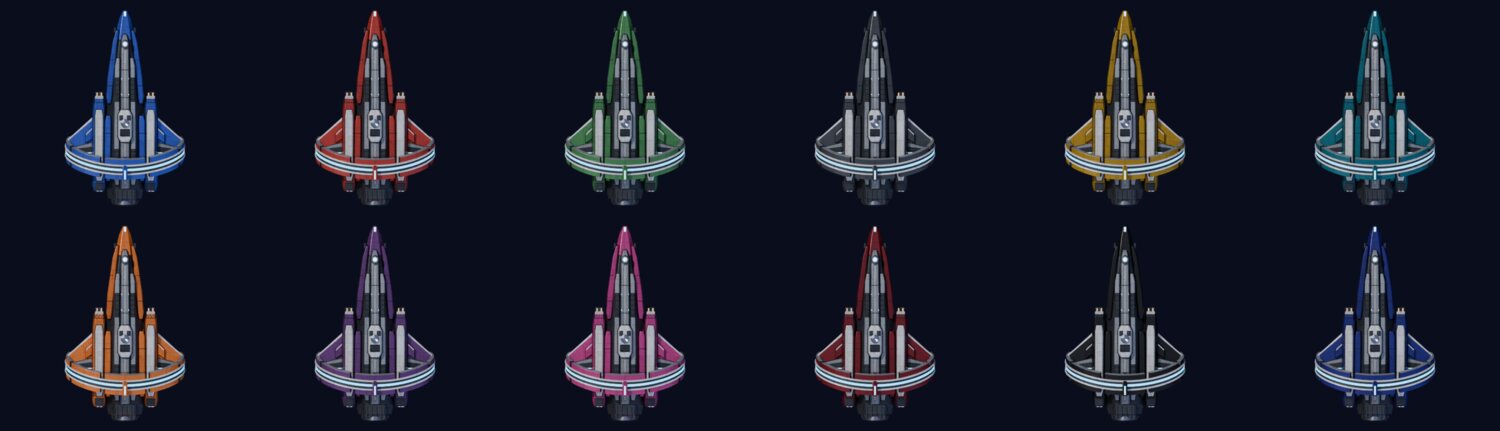
Twelve Wisps in different paint schemes

Build

Every skill worth training

All eleven skills now have a road from 1 to 99: something new at least every few levels, a notice when you level up, and a title at 50 and 99.

  • Salvage and Invention: a grappler (a claw on a cable) to start with; strip derelicts and take modules apart; wrecks in the belts that come and go; derelicts’ logs and bearings; tow a wreck home; have a research station study what you found and design Mk II and III variants.
  • Systems: power sliders, a battery bank, overclocks, silent running and load-shedding.
  • Construction: beacons, relays that grow by upgrades into an outpost, a workshop and docking ring at your relay, and repairs.
  • Navigation: the FTL drive in a slot of its own, gravity assists, precise drops and hot jumps.
  • Surveying, Refining and Logistics: deep surveys, a refinery aboard with by-products and batch jobs, market reports and prices over the relay network.
The skills sheet

Build

Stations with character, and your ship on show

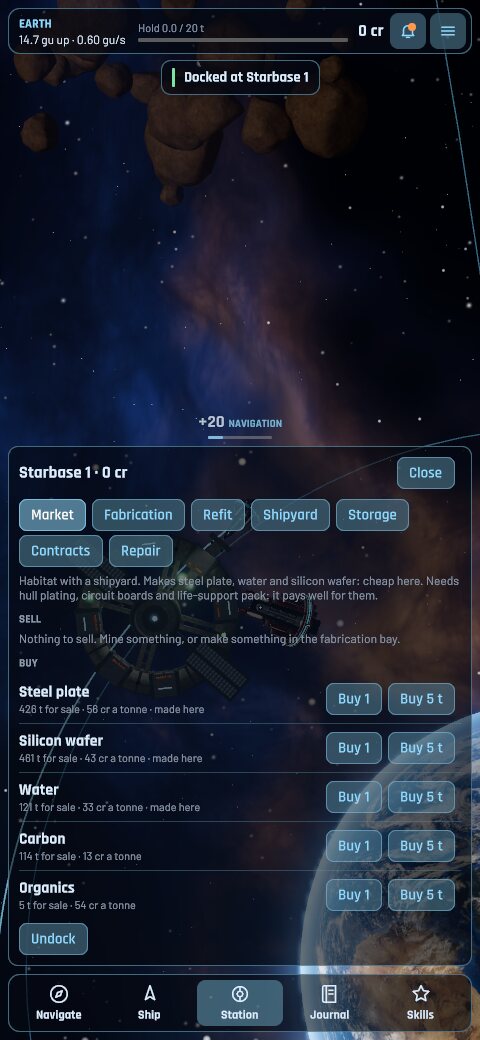
  • Station types that change what you can do: shipyards sell hulls and repair them, research stations study and design, refineries refine cheaply. Exploration data sells.
  • Hulls wear, and get repaired.
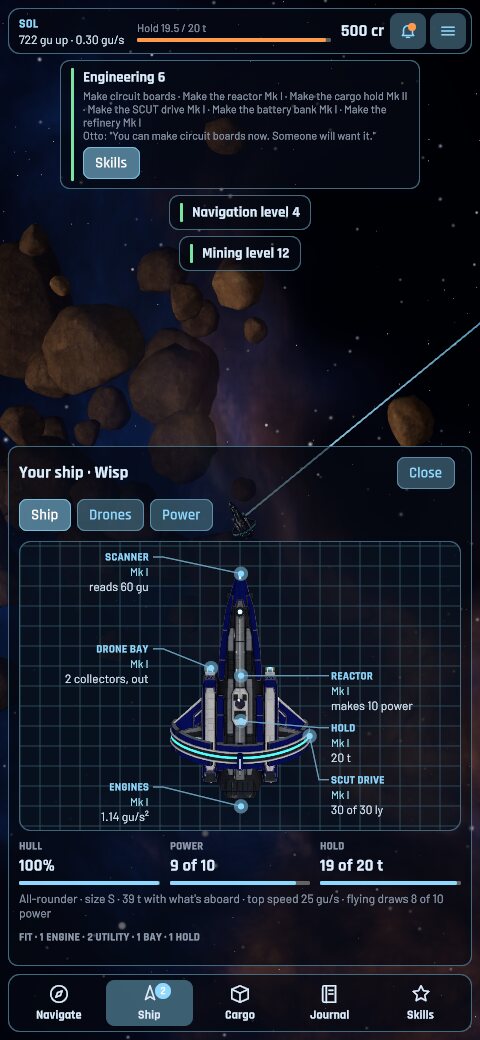
  • The Ship tab shows your ship’s own model with each system called out, and fitted modules show on the hull.
  • A power budget, module sizes, and Mk III parts: ceramic tiles, optics and drive cores.
Docked at Starbase 1The Ship tab

Build

The first story arc, and jobs for OTTO

  • A story engine, and the first arc, “The quiet sibling”, playable from Alpha Centauri onwards. No spoilers here.
  • OTTO found his voice: dry, short, and never a lecture.
  • Jobs you leave with OTTO run a full round and then wait; one tap sets them going again, and a whole production chain can be queued at once.
  • Behind the scenes, a balance simulator plays scripted players through a week in Sol on the game’s real rules, so the pacing can be tuned with numbers.

Build

Out past the planets

Playing the build kept raising the same question: “OK, what next?” This round answers it.

  • Every good says where it comes from and what it’s best used for.
  • Markets that buy and sell, with a profile for each station.
  • Fair contracts, with trip times and deadlines, and the Journal, with the goal you’re following pinned under the top strip.
  • A whole-system scan: hold still, sweep the system and see where the metal is.
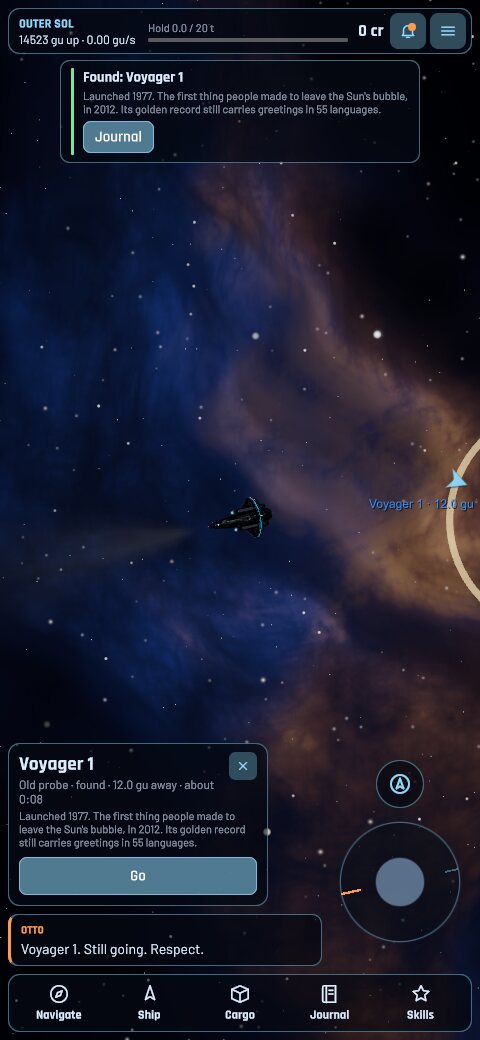
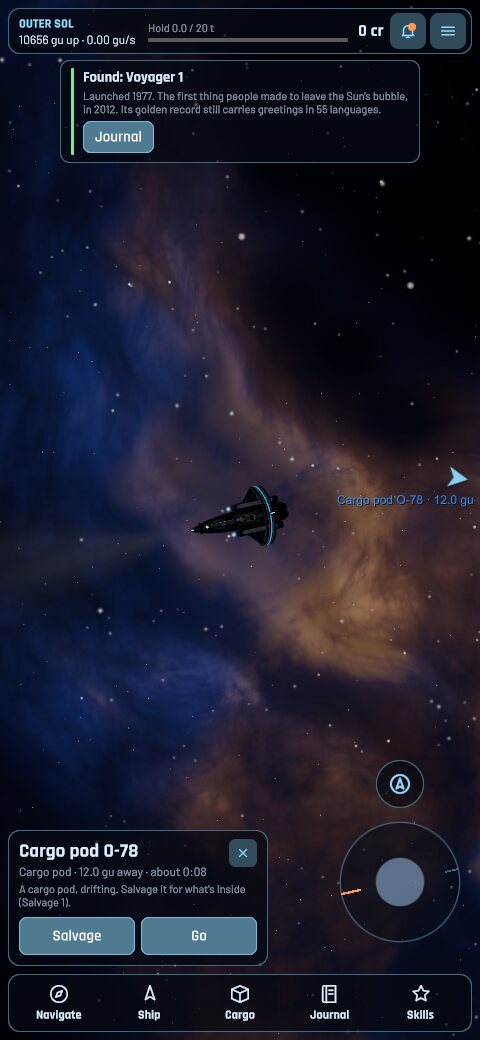
  • An outer system worth flying to: Sol’s old probes (Voyager 1 and 2, Pioneer 10 and 11, New Horizons), cargo pods, derelicts and dormant comets.
  • Life in space: NPC traders and miners flying real routes, and captains to hail.
Voyager 1, foundA cargo pod drifting in the outer system

Build

New ships, a new HUD, and better flying

  • Six hull designs, each with its own model, in a layered 2.5D look: armour in your paint, a sensor eye instead of a cockpit (you are the ship), and the FTL drive’s ring.
  • A redesigned HUD: a slim strip across the top, the target’s card beside whatever you tap, icon tabs, cargo as an inventory and skills as tiles.
  • Flying, second round: stronger engines, quicker turning, reverse thrusters (pull the stick back), and an arrow to a target that’s off screen.
  • Generated stars beyond the real neighbours, with routes to any of them.
The Venture and the Golem

Build

Leaving Sol, for the first time

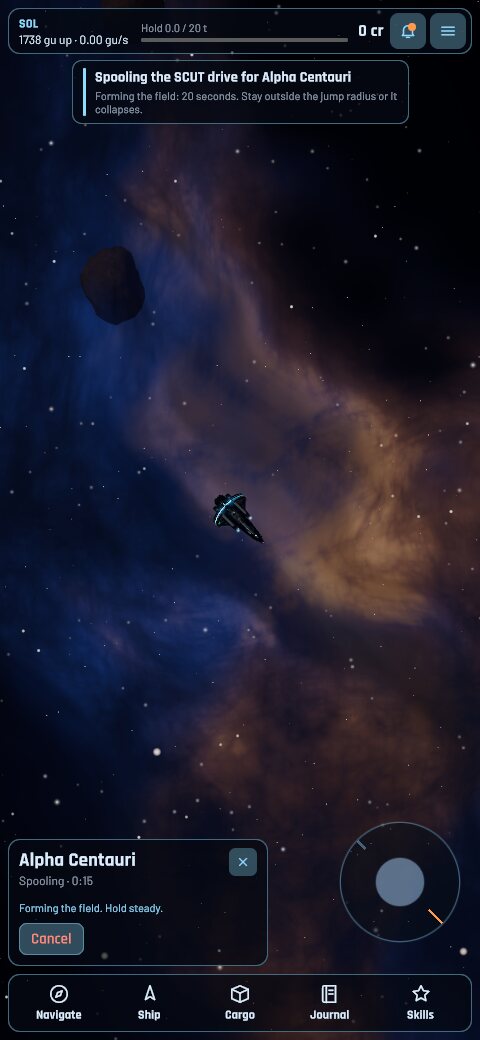
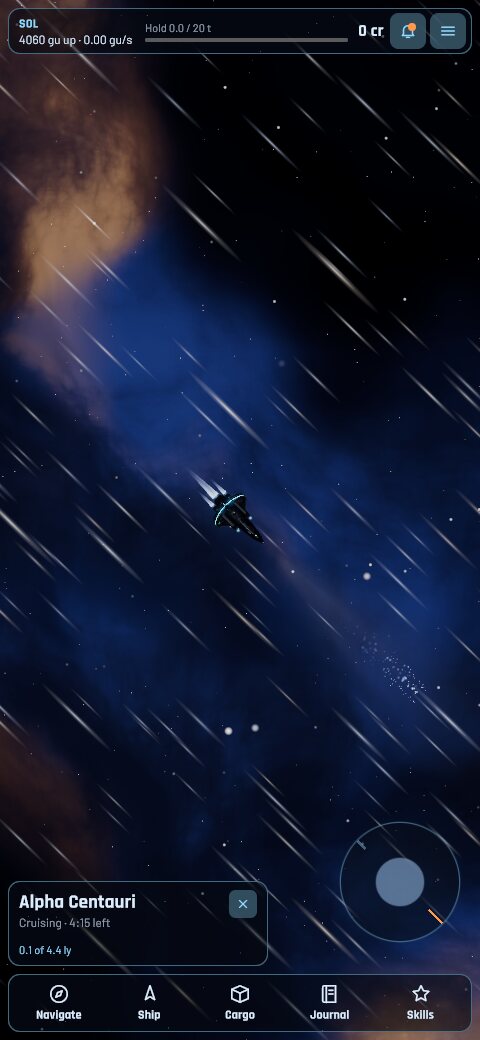
  • The FTL drive (then called the SCUT drive): fly past the jump radius, spool, cruise and drop out at the next star.
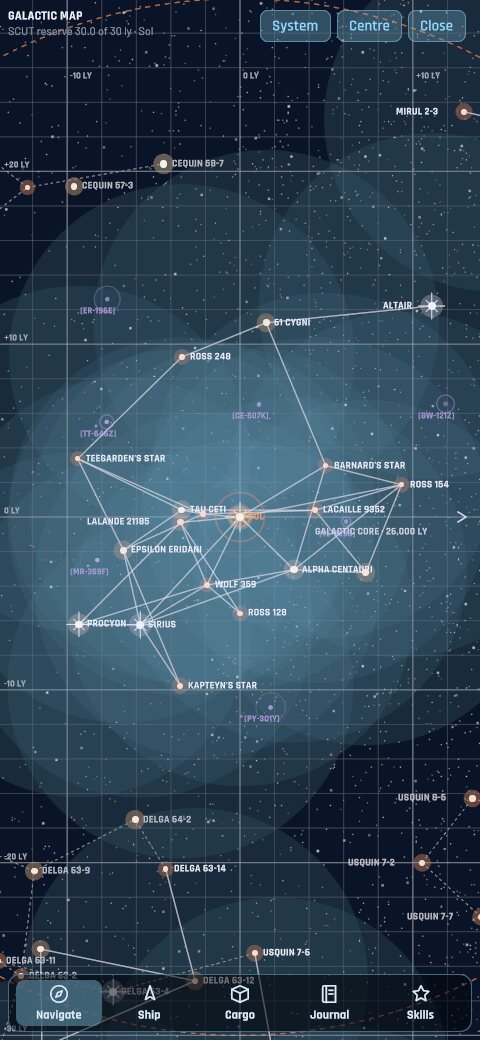
  • The Galactic map, drawn like an old star chart, with Sol’s real neighbours at their real positions and a system made for each.
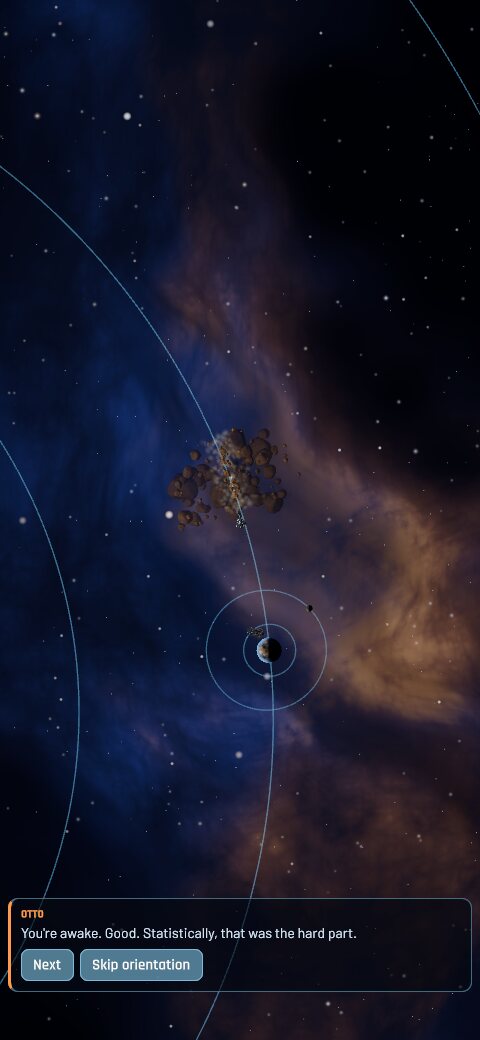
  • The Awakening: wake up in Sol with OTTO, fly, mine, make your first relay kit and join the network. Then a short flying lesson.
  • Charting the systems you reach. Contracts on station boards.
  • Skills, a moving market, a four-step fabrication chain and refits.
  • Sound: effects made in code, heard the way the ship would hear them through its own hull, and lofi music that comes and goes.
Waking up with OTTOThe Galactic mapSpooling the FTL drive for Alpha CentauriCruising between stars

Build

Sol arrives

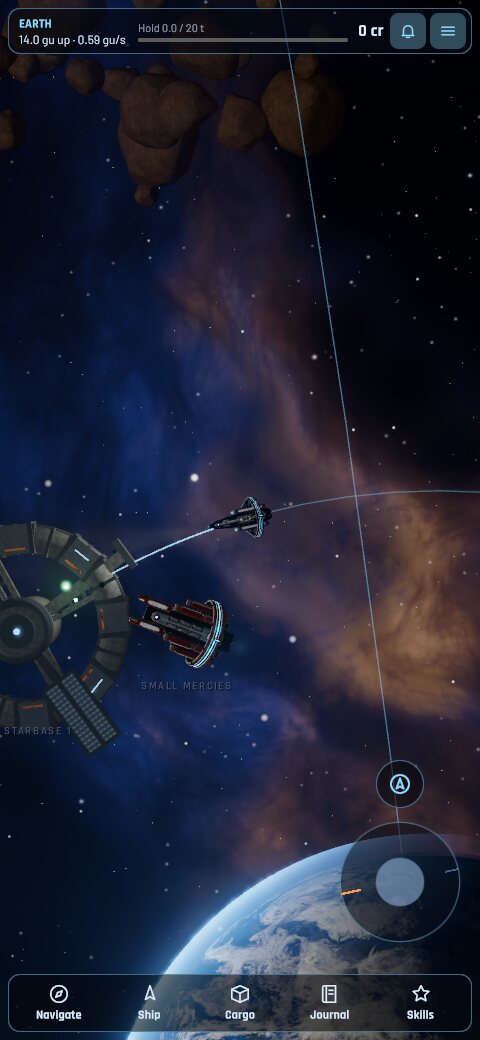
  • The game moves to Unity: flying by hand, targets, the autopilot, docking, and the whole mining loop (scan, bust, collect, sell).
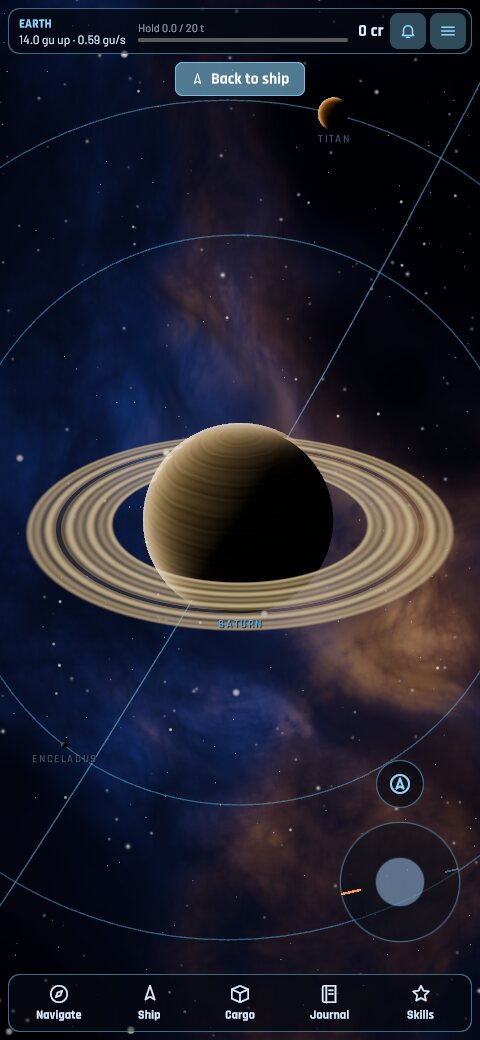
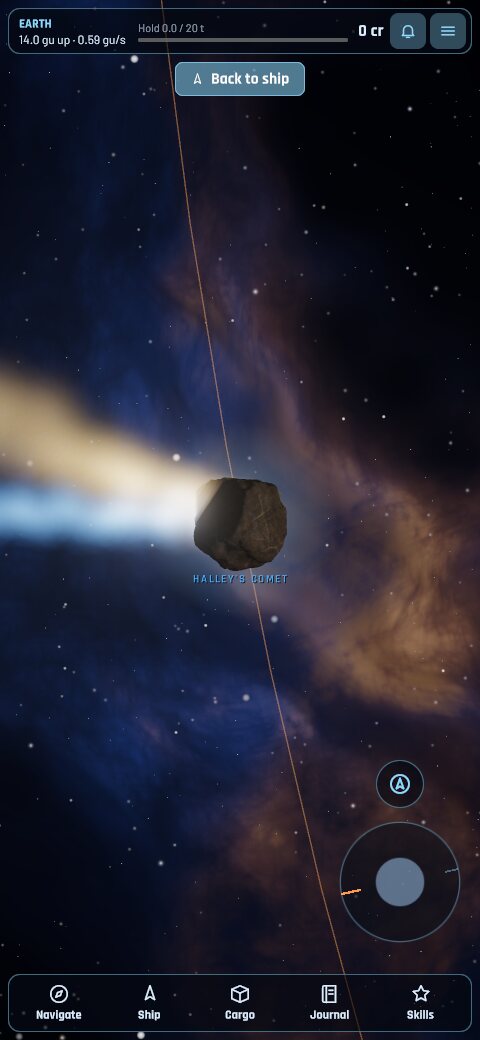
  • The real Sol, scaled for play: eight planets, twelve moons, the main belt, the Kuiper belt and Halley’s Comet, with NASA maps and painted worlds, under a blue and ember sky.
  • The first HUD, and saving.
Leaving Starbase 1 above EarthSaturnHalley's Comet

Milestone

The prototype is done

A quick browser prototype answered the first question: are momentum flight and drone mining fun on a phone? They are. Its tuned numbers carried over into the real game.